- 2,027,840 Acre Feet
- 65 Miles of Shoreline
- Surface Area 12,250 acres
- 270 feet deep
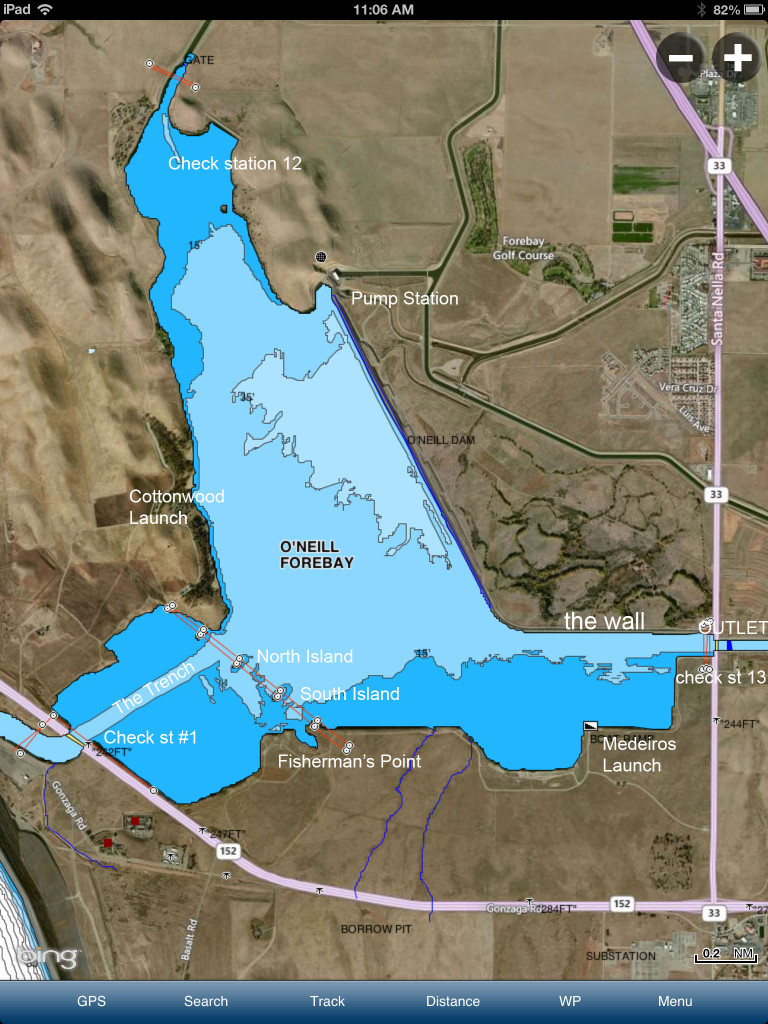
- Oneill Forebay Water Heights full=222.60 ft (<219ft is too shallow to boat) Water data
- San Luis Reservoir full=543 ft Water data
San Luis Reservoir is one of California’s largest reservoirs and a critical component of the state’s water supply system. In fact, with a capacity of more than 2 million acre-feet (AF), it is the largest off-stream storage facility in the world.
I always dreamed of knowing a body of water so well that I could catch fish in it at will, in any weather, in any conditions. I thought that might happen later in my life when I retire to some small lakefront or riverfront cabin–like ” On Walden’s Pond” . The one thing I have realized fishing all over the world is sometimes, you overlook the best fishing of all and it’s right under your nose. Sometimes those moments come by accident and luck; whether it’s catching and enormous bass in my backyard lake- Calero Reservoir- or casting to 20lb mudding carp in the flats of the Perc Pond near my office, or catching a 12 inch trout in the creek behind Leland High School on an indicator and nymph. I forgot that the main reason I started fishing for fun, mainly because it is was easy and cheap. It is time for me to understand San Luis Reservoir–really understand it. It’s the best world class piece of fishing water within and hour of my house (next to the delta).
These pages are dedicated to that goal–to crack the mystery of San Luis Reservoir Stripers. I started fishing SLR sometime around 1970 when I was 13 years old. I remember when my dad would bring me to the lake where he taught me to catch fish with anchovies from the shoreline. He also taught me to clean and dress stripers so that my mother would not complain about the fish we brought home-“Ikejime” (humane dispatching of a striper to preserve taste). My dad was a meat fisherman and I learned how to use a scalpel (a fillet knife) at age 13 because of his obsession with bringing home the fish. Maybe that contributed a bit to my current profession as a dentist but back when I was young, it was all about fishing and quantity. San Luis was the meat locker. Today, I am more about understanding the biology behind the fishing. As well as keeping up to date with the political threats to this great fishery that was born of mans inspiration to control water to the masses. In short, the wonderful fishing in San Luis is a man made phenomena populated by a non native species-the largest off stream reservoir in the world with Stripers.

The Lake-Man Made Striper Habitat dedicated by John F Kennedy
JFK gave this speech at the groundbreaking of the project actually detonating an explosive at the projected water level of the finished dam on August 18th 1962. The dam project was completed in 1967 but President John Kennedy never saw the completed project as he was assassinated in Texas a year later on November 22, 1963. …how we set things in motion not knowing what the future will bring.
History and Biology of Stripers
Captain John Smith, wrote in his journal in 1614 “that Striped Bass was a most sweet and wholesome fish as ever I did eat” And In 1634: William Wood, in his New England’s Prospect, called the Striped Bass “one of the best fishes in the Country . . . a delicate, fine, fat, fish.” Striped Bass were also served at the nations first Thanksgiving.
The Striped Bass, scientifically referred to as Morone saxatilis is endemic to the East Coast. The striped bass has been a prized fish since the Plymouth Colonies in 1670 where they were commercially fished. In 1607, Captain John Smith found the Chesapeake Bay waters clean and clear, free of the phytoplankton clouds that followed in later years. He wrote in 1614 that the fish seemed so plentiful that one might walk “dryshod” across their backs over the river. Striped bass can live up to forty years and reach weights greater than 100 pounds at nearly five feet in length, although individuals larger than 50 pounds are considered an absolute trophy fish and a possibly once-in-a-lifetime.
The entire California Striper fishery is the result of 435 fish planted on two occasions–135 fingerlings in 1879 and 300 in 1882. Fingerling Stripers were first introduced into San Francisco bay in 1879 and were place in the Carquinez Straits. Transported by train from New Jersey’s Navesink River, the fish prospered in Delta and San Francisco Bay. Six months later, an eight inch bass was reported to have been caught in Monterrey Bay. The first confirmed report in SF Bay occurred several months after that. Only 4 years later on October of 1883 a fisherman reported catching a 16 lb striper in the Sacramento River! Imagine what the DFG would have said today about dumping a bunch of foreign fish into the Bay! The striper population in the Bay exploded–between 1889 and 1892 the yield of stripers by commercial fishermen increased 250 percent. There is a record of a party boat in SF bay that landed 1500 fish in one boat in 1894 with an average size of 7-14 lbs. The stripers were fished commercially until 1935 when the local sports fishermen managed to lobby against the commercial fishery to improve their sport! There are many observations of schools of spawning stripers in the San Joaquin River in the 19th and early 20th centuries. In contrast, commercial salmon fishermen in the Sacramento River rarely reported catching striped bass during the same time period. Today, stripers are very prevalent in the Sacramento and large schools are often observed.
Times have certainly changed. Stripers have established themselves as far north as the Umpqua River in Oregon and as far south as Redondo Beach in Los Angeles. What a scary thought that a couple hundred fish dumped into the bay could change the entire dynamic of a coastal fishery forever! A 36 Inch, 20lb Striper is about 12 years old. You can count the rings on the scales to determine age. Stripers migrate into rivers and estuaries with current or tidal oscillations to spawn in the spring. There have been reports of Stripers spawning in the Pajaro and Salinas river estuaries and some fly fishermen. Fly fishermen have been targeting these estuaries that are only open weekends and Wednesdays to steelhead fishermen. March and April are good months to fish the river using a fly fishing combo. Striper eggs need to drift and suspend in current to develop into fry which takes 2 days. Female stripers start annual spawning at 18 inches and a 5 pound fish can produce over a million eggs. Yearly surveys taken since 1946 of the distribution abundance of Striper fry indicate the the fishery is healthy. And, as many species in the Delta decline due to water fluctuations, Stripers are the least effected. As one Biologist recently put it
Striped bass are extremely prolific and attempts to propagate them artificially are unwarranted. So many fry are produced through natural propagation that almost any contribution from artificial sources would be superfluous. Once established in an area any decline in the population is most likely the result of environmental factors rather than insufficient natural propagation.
San Luis Reservoir Dam Raising (edit 10/2023)
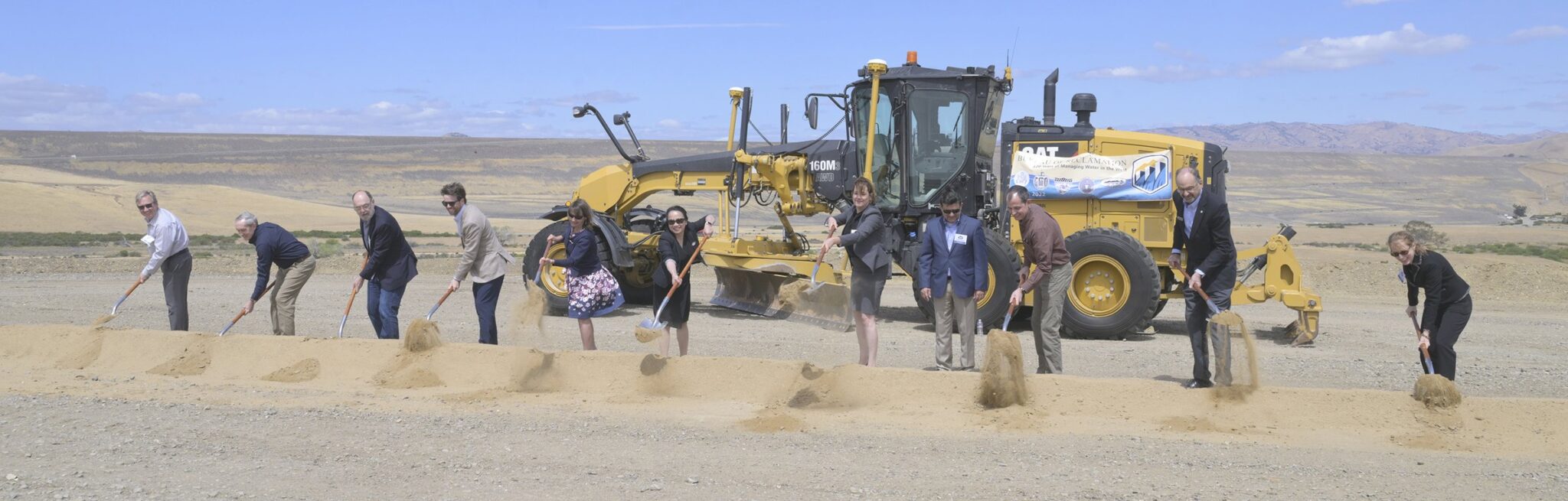
June 17, 2022 on Kennedy Hill where Groundbreaking took place in 1962
In an effort to increase the availability of water during drought years in California. The project that will raise the B.F. Sisk Dam at San Luis Reservoir by 10 feet broke ground on June 21, 2022. It will add another 130,000 acre feet of critical off-stream water storage and will increase the length of the dam to 392 feet and seismically retrofit it making it safer. The expansion project will piggyback on a seismic re-enforcement project already underway for B.F. Sisk Dam.
The federal project is expected to cost $1.1 billion and take nine years — even with crews working 24 hours a day beginning later this year. Altogether, more than 10 million cubic yards of rock, gravel, and soil will be moved from nearby hills to harden and raise the now 382-foot high dam . More than 10 million cubic yards of rock, gravel and soil will be moved from the hills near the dam — roughly the equivalent of 1 million dump trucks full — to harden the dam. The reservoir will not have to be drained.
Water is diverted from the California Aqueduct during heavy flow periods and stored there until needed by area farmers as well as agricultural and urban users farther south .It will create enough storage to supply more than 2 million people, a million acres of farmland, and 135,000 acres of Pacific Flyway Wetlands.
The reservoir also supplies water for 60,500 acres in the Santa Clara Valley.
The project received a $100-million investment last March from the Infrastructure Investment and Jobs Act which was part of the $500 million awarded to the US Bureau of Reclamation over the next five years to support critical dam safety projects. The project is being funded mostly by the federal government with some state contributions.
It was anticipated that the lake would be closed to boating and fishing for 7 years, however, as of the end of 2022, Dinosaur Point has been left operational with no anticipated closure.
The Basalt launch area is now closed and will be used to house workers on the project.
Where the Water Comes From
O’Neill Forebay and San Luis Reservoir, located in California’s Central Valley, are part of the California State Water Project (SWP) and the federal Central Valley Project (CVP), which are major water management systems in the state. The water that feeds O’Neill Forebay and San Luis Reservoir primarily comes from several sources:
- Sierra Nevada Snowmelt: Much of the water in these reservoirs originates from the Sierra Nevada mountain range, where snow accumulates during the winter months. When the snow melts in the spring and summer, it flows into rivers and streams, ultimately making its way into the California aqueducts and canals that supply O’Neill Forebay and San Luis Reservoir.
- Delta Diversion: Some water for these reservoirs is diverted from the Sacramento-San Joaquin Delta, where freshwater from the Sacramento and San Joaquin Rivers is collected and pumped into the aqueduct systems. This helps transport water to the Central Valley and Southern California regions.
- Local Watersheds: Water from local watersheds and tributaries also contributes to these reservoirs. Rainfall in the region can directly flow into the reservoirs or enter through local rivers and creeks that feed into them.
- Pumping Stations: There are pumping stations along the aqueduct systems that help lift water to higher elevations and transport it over long distances. These pumping stations play a crucial role in moving water to O’Neill Forebay and San Luis Reservoir.
It’s important to note that water management in California is a complex and highly regulated process, with multiple agencies involved in the allocation and distribution of water from various sources to meet agricultural, municipal, and environmental needs. The California Department of Water Resources (DWR) and the U.S. Bureau of Reclamation are among the key agencies responsible for managing and overseeing the operation of these reservoirs and their associated water delivery systems.
The main pumping station that draws water directly from the Sacramento-San Joaquin Delta to the California Aqueduct is the “Harvey O. Banks Pumping Plant.” The Harvey O. Banks Pumping Plant is a critical component of the California State Water Project (SWP) and is operated by the California Department of Water Resources (DWR).
Located in the southern part of the Sacramento-San Joaquin Delta near Tracy, California, the Harvey O. Banks Pumping Plant lifts water from the Delta and pumps it into the California Aqueduct. This facility plays a crucial role in the conveyance of freshwater from the Delta, which serves as a major source of supply for various regions of California, including Central and Southern California.
The main pumping station that feeds water into O’Neill Forebay is the “Dos Amigos Pumping Plant,” which is part of the California State Water Project (SWP) and managed by the California Department of Water Resources (DWR). The Dos Amigos Pumping Plant is located near the town of Los Banos in Merced County, California.
The Dos Amigos Pumping Plant plays a crucial role in lifting water from the California Aqueduct, which transports water from the Sacramento-San Joaquin Delta and other sources, and then pumping it into O’Neill Forebay. From O’Neill Forebay, water can be further distributed to San Luis Reservoir and other facilities for storage and delivery to water users in Central California.
The pumping plant is named after the nearby Dos Amigos Pumping Canal, which helps convey water from the California Aqueduct to the pumping plant. This facility, along with other infrastructure in the region, contributes to the management and distribution of water to meet the agricultural and municipal water needs in the area.
In order for a fish to make it from from the Delta to the Oneill Forebay and San Luis Reservoir, It has to survive at least three pump stations.
Fish Screening
The C.W. “Bill” Jones Pumping Plant is a key component of the Central Valley Project (CVP), one of the nation’s largest systems for storing and moving water. The nearby Tracy Fish Collection Facility is operated in conjunction with the pumping plant to protect and salvage fish from pump operations.
The pumping plant near Tracy, California, lifts water at the southern end of the Sacramento-San Joaquin Delta into the Delta-Mendota Canal (DMC), which delivers water to CVP water service contractors, exchange contractors, and wildlife refuges. The contractors provide agricultural and urban water service in the western San Joaquin Valley, and portions of San Benito and Santa Clara counties. The pumping plant, operated by the San Luis & DeltaMendota Water Authority for Reclamation, lifts water nearly 200 feet from the Delta into the DMC through 15-foot diameter pipes with six 22,500-horsepower motors capable of pumping a total of 9,200 acre-feet per day. The pumping plant, operated by the San Luis & DeltaMendota Water Authority for Reclamation, lifts water nearly 200-feet from the Delta into the DMC through 15-foot diameter pipes using one or more of the six 22,500-horsepower motors (one used for back-up). Due to subsidence issues in the DMC, pumping capacity is generally limited to 4,600 cfs. The DMC extends nearly 120 miles to the south, ending at the Mendota Pool about 30 miles west of Fresno. The CVP water is also conveyed with pumping units to the San Luis Reservoir for deliveries to CVP contractors through the San Luis Canal.
The fish collection facility is a complex system of louvers, bypasses, and holding tanks operated to protect and salvage native-area fish. The facility has undergone various upgrades and modifications over the years, and its history dates back to the early 1950s when its original components were built. Since then, it has been expanded and modernized to improve fish protection measures and monitoring capabilities.The facility collects Sacramento-San Joaquin Delta fish species as a primary mitigation feature for the pumping plant and returns them to the Delta. The fish facility was constructed in the mid-1950s. Since then, Reclamation has made periodic improvements and continues to adopt state-of-the-art technical and biological techniques to reduce fish losses associated with pumping. Threadfin shad, striped bass, and American shad are the most prevalent of the nearly 60 species of fish collected at the facility. Listed species include Delta smelt, winter-run and spring-run Chinook salmon, steelhead, and green sturgeon. Fish salvage is monitored by sampling and counting collected fish every two hours. Monitoring includes identifying fish species, collecting tissue samples from listed species, processing monitoring tags, and recording and tracking the amount of fish salvaged. Reclamation is currently implementing an applied research program for improving fish salvage at this collection facility. The goal is to develop and implement new fish collection, holding, transport, and release technology that will significantly improve fish protection at major water diversions in the South Delta region of the Central Valley. These research activities are funded by the Tracy Fish Facility Improvement Program and are primarily performed by Reclamation fishery scientists and engineers at the Denver Technical Service Center and the Tracy Fish Collection Facility
Quagga Mussel Inspection
Does it make sense that if you don’t inspect boats in waterways that feed a specific lake, then the inspections are meaningless? What a waste of time and effort when minnow buckets are not inspected or float tubes launch almost anywhere on the lake.
To pass the inspection follow these simple steps:
- Inspect all exposed surfaces – mussels feel like sandpaper.
- Wash the hull thoroughly, removing all visible mud, plants and animal material.
- Drain all water from your hull, pull drain plugs and motor water lines and tip outboard down to drain.and dry all areas.
- Wash and dry everything that came in contact with water including trailer.
- Keep watercraft dry between launches into different fresh water areas.
If a boat moved from an infested area will be launched in waters that are not infested with zebra or quagga mussels, the general recommendation is to keep the boat out of water and let it dry for a minimum of 30 days after cleaning all equipment and draining all possible sources of standing water. However, such “quarantine” times may be reduced depending on local temperatures and relative humidity’s.
SAFETY
San Luis Reservoir can be a very scary place to boat. When the wind is blowing from the east, at 20 mph it can generate 4 foot wind waves that come rapidly. Many boats under 18 feet have been swamped by such waves and depending where you are on the lake, getting to shore can be tough if you are coming out of the water on rocks near the dam. San Luis Reservoir State Recreation Area consists of three lakes: San Luis Reservoir, O’Neill Forebay, and Los Banos Creek Reservoir. Each lake is susceptible to sudden changes in wind and weather conditions. Wind warning and lake closure lights are used on San Luis Reservoir and O’Neill Forebay to alert boaters of the current wind conditions. On San Luis Reservoir, watch for the 3 wind warning and lake closure lights near the Basalt entrance station, Quien Sabe Point, and Romero Visitor Center. On the O’Neill Forebay, wind warning lights are located near the old Medeiros boat ramp and above the South Beach area.
- Amber lights signify caution conditions for winds or other concerns.
- Red lights indicate the lake is closed to boating and all vessels are required to immediately vacate the lake when the red lake closure lights are on.
| Condition | Light Color |
| Okay | All lights off |
| Use caution | Amber |
| Closed to boating | Red |
Kiosk at ONeill Forebay (209) 826-4714
One incident still weighs heavily on my memories of San Luis – the death of Mark Harrup who perished flyfishing in San Luis Reservoir June 2006. Mark was a great guy, professional flyfisherman, and JV Golf Coach at Leland High School. He was as experienced a flyfishermen as I have known at 29 years of age and worked for San Jose Fly Shop. Mark who was fishing with Jeff Ketelson, who survived the incident, told the story of how it happened.
Apparently, Mark and Jeff had been fishing in the safer, less windy areas of the lake when the wind died down. They decided to make a run for their current favorite spot near the trash racks. For those that don’t know the lake, the trash racks are a series of structures near the face of the dam. They hooked a few stripers then got into a double. Neither one had notice a small amount of water splashing in the back of the boat. By the time they realized this, they were drifting close to the dam. They immediately tried to start the motor and bilge pump and both were failing. After a few minutes they were able to start the motor and decided to get the boat running fast so they could get the water out. With so much water in the boat, the engine was riding low and when it got wet, it failed. Soon the boat capsized and they were in four foot waves with the sun going down. For a while they were able to hang on the boat but the air bubble holding it up disappeared the boat was sinking. They had a small piece of debris and fuel tank to grab onto. Mark was struggling and Jeff pushed the piece of wood to him and made a swim for the fuel can that was quickly getting away…Soon after they lost sight of each other and Jeff made it to a cable near the trash racks where he hung on to life for the next three hours before being rescued just before midnight.
I guess the message here is that not only do things happen fast; they are usually a series of events that create a catastrophic ending. Mark was not a strong swimmer and was wearing jeans and heavy shoes. Mark’s boat, a 15 ½’ Cobia, was not a “floatable”. Even I assumed it was. It’s easy to say they should have done XYZ. Jeff told me they knew there were some problems mounting. The thought was that they would be able to take care of it. Not until the boat was capsized did they realize how serious the situation had become. I asked about the life jackets. He said that when they realized the boat was going to flip it was too late to grab them. They thought they could float with the float safely back to shore, not knowing it was going to sink.
Striper Records
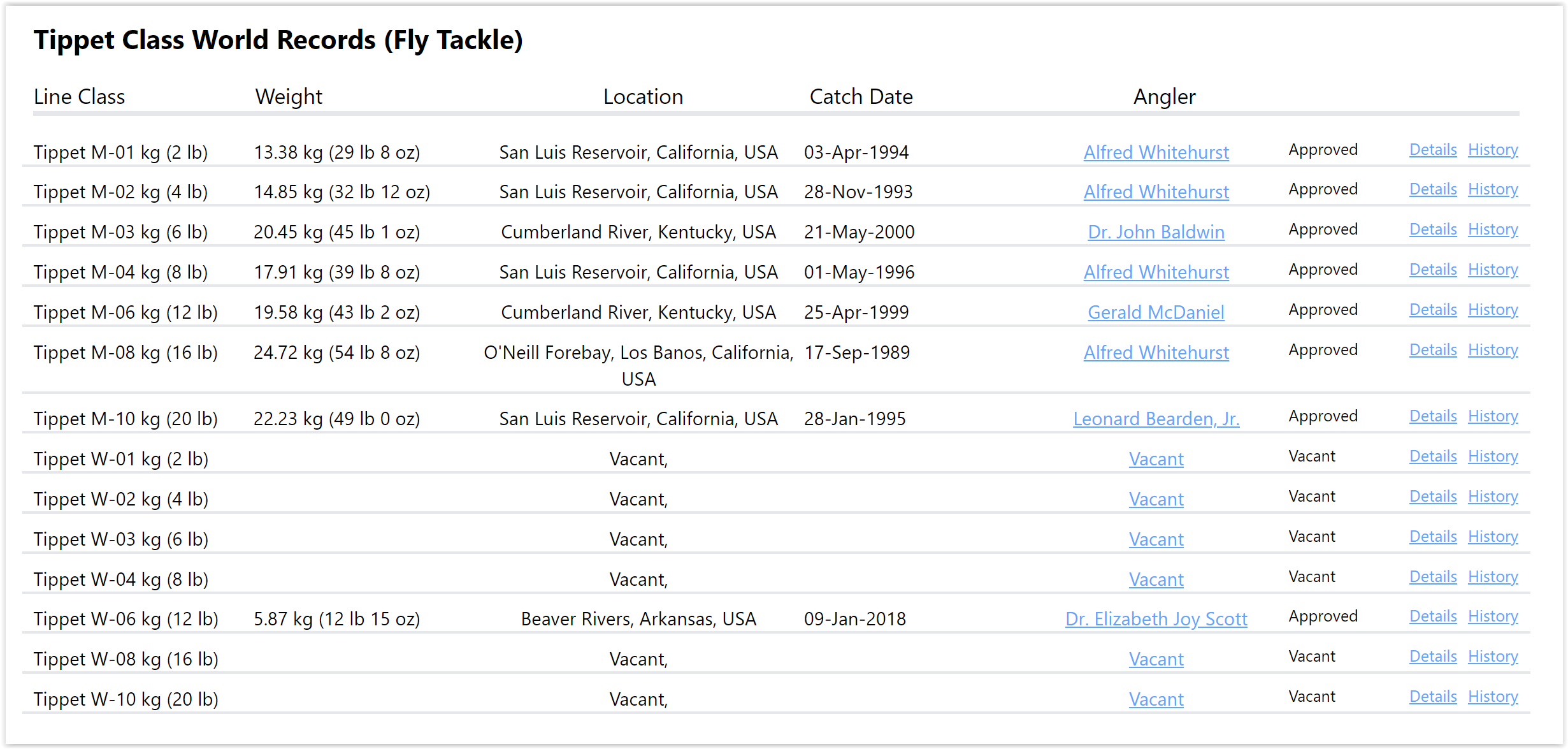
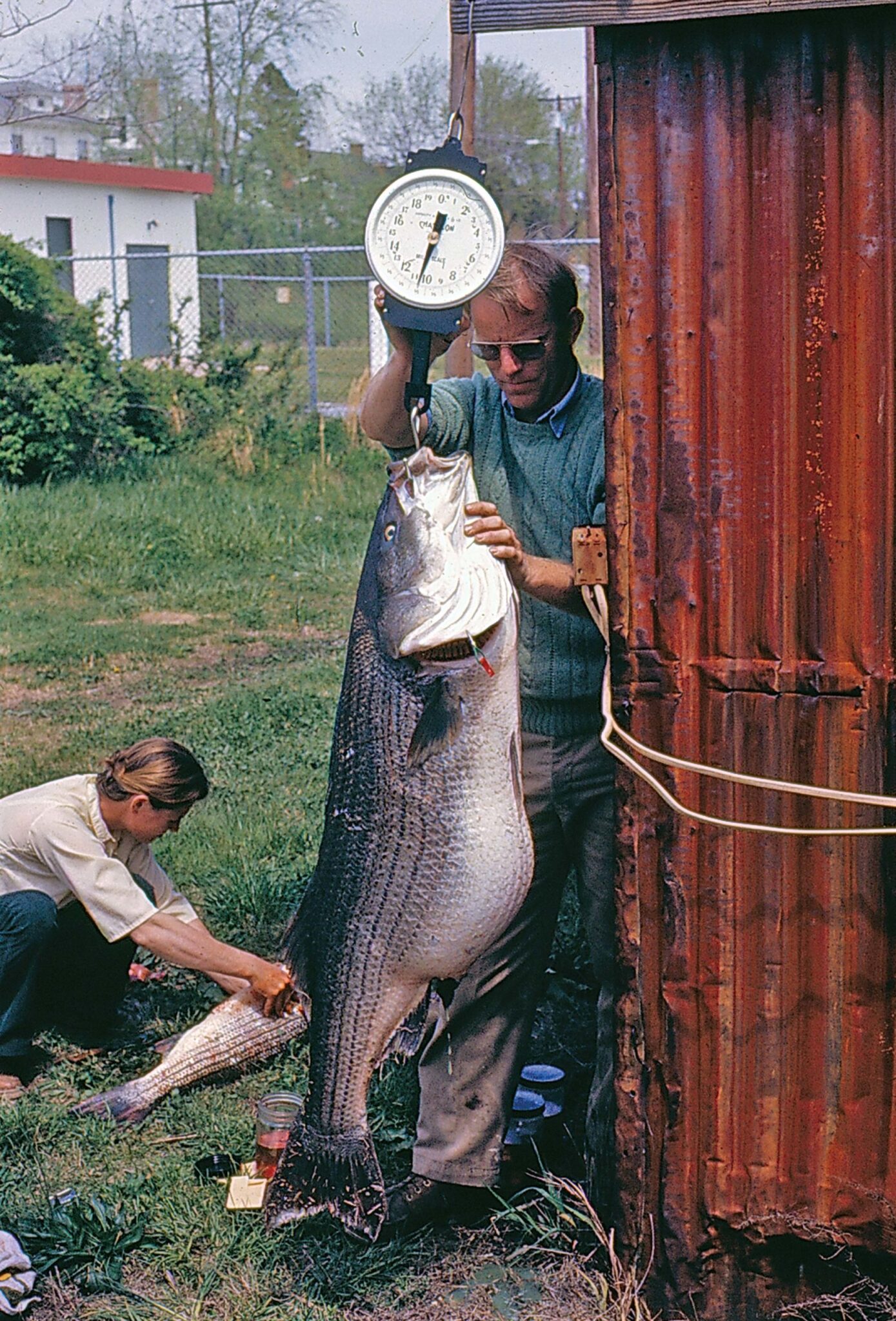
The Biggest IGFA certified Striper ever caught on all gear as of 2022 was 81lbs 14 oz caught near Long Island Sound in the salt in 2011 by Gregory Myerson but stories of bigger fish caught that were never officially recorded. There exists old pictures of stripers weighing 92 -110 lbs that never made it into the record books. Stripers can reach amazing large sizes and like the northern California trout that were stocked in Lake Strobel (Jurassic Lake). all it takes to create a giant stripers is an unlimited food source and water. There are some guides and old fishermen who believe that sportsfishing has killed the San Luis Fishery . In reading the diary of my mentor, and comparing them to my fish counts and observations, Ive noticed that maybe the fishery in San Luis is better! Stripers grow fast–five inches long in the first year, 11 inches at the second, 16 inches at the third, and 20 inches at the end of the fourth year. According to Dan Blanton, A striper weighing 108 lbs was verified by the DFG in San Luis Reservoir. The Stripers caught in San Luis are classified as freshwater Landlock Stripers and San Luis held the world record for that in 1992 with a 67 1/2 lb striper. In 2008, a baitfisherman caught a 71.5 lb striper out of the forebay on a pile worm and ate it before it was recorded as the states largest striper
Seems to me like the fish being caught are bigger and as abundant as they were in the 70s with sportfishing being the only real stressor other than drought. And I would add not much of a stressor since biologist argued that eradicating the Striper Population in the Sacramento River to bring back Salmon populations would be impossible even if you set no limits on Striper Sportfishing. Comparing the size of the fish Im catching these last 10 years with those in Len Bearden’s Diary. The Schoolie size stripers are averaging larger even though the frequency of over 20lb fish has diminished. But perhaps I’ve just become better at catching them and it’s an illusion. Some fisherman believe that San Luis today has radically changed for the worse from 30 years ago from overfishing. But, Dan Blanton recently caught his PB stirper out of San Luis in 2020 after fishing it his entire life for 50 years. Purely speculation but when you consider that a 20lb striper is 5 years old, maybe all that is needed is 5 years of lots of water year round which was the case in the 80, and early 90s but not recently. Only in these last 2 years after the great California drought have we seen a couple back to back years of a Full lake in the spring and these last couple years has seen improvements in the quantity and quality of San Luis Fish. Maybe the large fish are less abundant or smarter, but they are still there as trollers like Roger George are getting them every month of the year. Be ready when the water levels stay higher and the big ones come to shore to feed.
Migration and Stocking
The migratory behaviors of coastal striped bass are more complex than those of most other anadromous fish, which spend most of their adult lives in the ocean but migrate up rivers and streams to spawn. Striped Bass seasonal movements depend upon the age, sex, degree of maturity and the river in which they were born. Even though Strippers are anadromous, scientist believe that the damming of rivers has led to some species becoming landlocked . There are very few successful spawning populations of freshwater striped bass that retained a landlocked breeding population . I have talked to some biologist who believe that the San Luis Stripper population is one of those freshwater sustained systems with the fish moving to and from the San Joaquin river watershed and in and out of the lakes through the aqueducts that connect many of those reservoirs. . San Luis Reservoir has never had a formal stocking program in its history. Although some talk about an attempt to stock stripers in the Lake and Forebay in the 80’s that resulted in an orgy of feeding by the large stripers in the lake resulting in no net gain in the fishery.
An entry in Len Bearden’s Diary states on 6-26-1992:
“Had a call from Al that they had stocked 4-6 inch stripers at San Luis Creek Launch ramp. The fishing had been hot Wed. and Thurs.. Big fish had moved in to feed on them. He had caught many fish last night from 5-18 lbs. The fish were still there but not in the same quantity. I took one good fish 30.5 inches about 10 lbs. Dave hooked three and lost all of them. One seemed to be a really good fish. He almost got spooled before it came off. Al took 3 from 6-11 lbs. There was a 5 lb and one about 21 lbs also taken by other anglers.”
I believe that the populations in San Luis parallel those in the delta reaching equilibrium populations with its Delta San Joaquin water source. Save the delta and you save San Luis. Although some people believe that the good old days of San Luis are over, I have the feeling that the lake is as good as it has ever been. Maybe that is just wishful thinking, but then I am an optimist.
What Can You Eat from the Delta and the Lake
The Organization that is in charge of determining safe levels of fish to consume is the Office of Environmental Health Hazard Assessment California Environmental Protection Agency or OEHHA. The conclusion of the last three studies have shown elevated levels of Mercury, PCBs and heavy metals in Stripers especially those over 27 inches. Current guidlines are as follows
When consuming fish from San Luis Reservoir, women 18-45 years and children 1-17 years may eat two total servings per week of Tule Perch or one total serving per week of American Shad. They should not, however, eat black bass species, Common Carp, or Striped Bass. Women 46 years and older and men age 18 years and older may eat 5 total servings per week of Tule Perch, or two total servings per week of American Shad, or one total serving per week of black bass species, Common Carp, or Striped Bass. When consuming fish from O’Neill Forebay, women 18-45 years and children 1-17 years may eat six total servings per week of Inland Silverside or one serving per week of black bass species, catfish species, or Striped Bass. Women 46 years and older and men age 18 years and older may eat seven total servings per week of Inland Silverside, or two total servings per week of black bass species or Striped Bass, or one serving per week of catfish species. One serving is an eight-ounce fish fillet, measured prior to cooking, which is roughly the size and thickness of your hand. Children should be given smaller servings.
A Serving is defined as the size and thickness of your hand.
Pretty Scary! Release the really big fish (over 10 lbs) and eat only the little ones (less than 10lbs-aprox 27 inches) to be health safe and fish conservative. A Ten lb fish is aprox 5 years old.
The Good Old Days
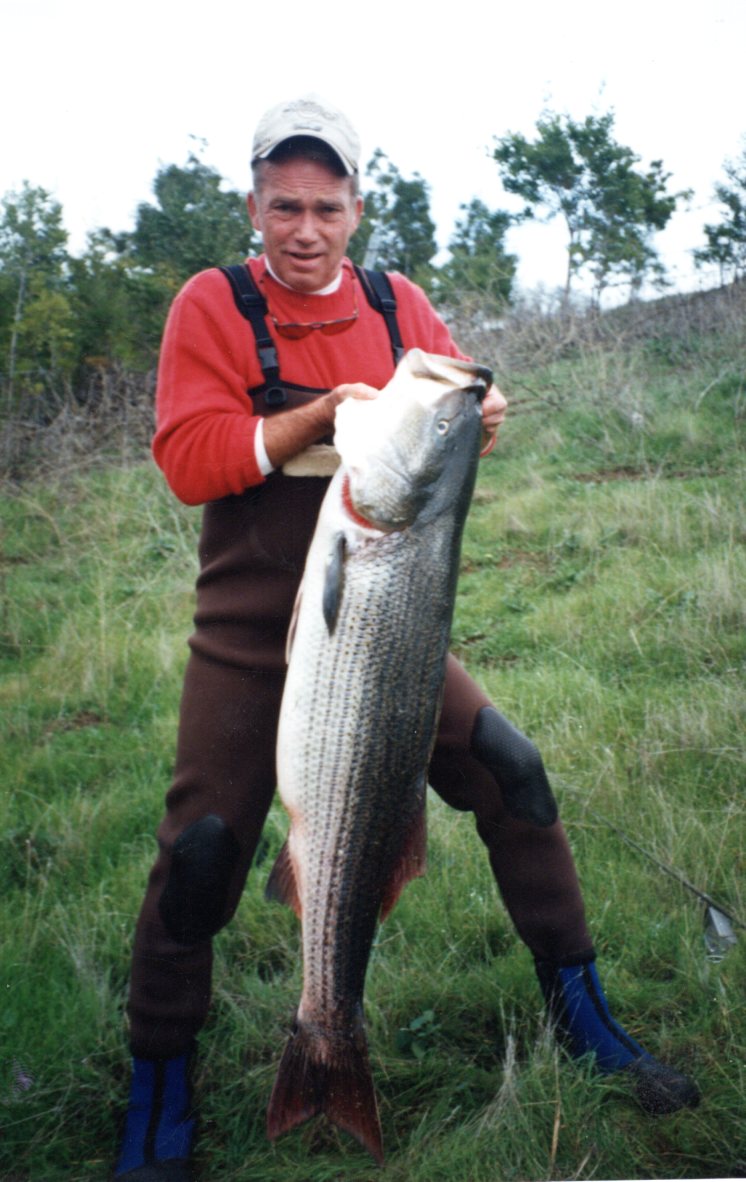
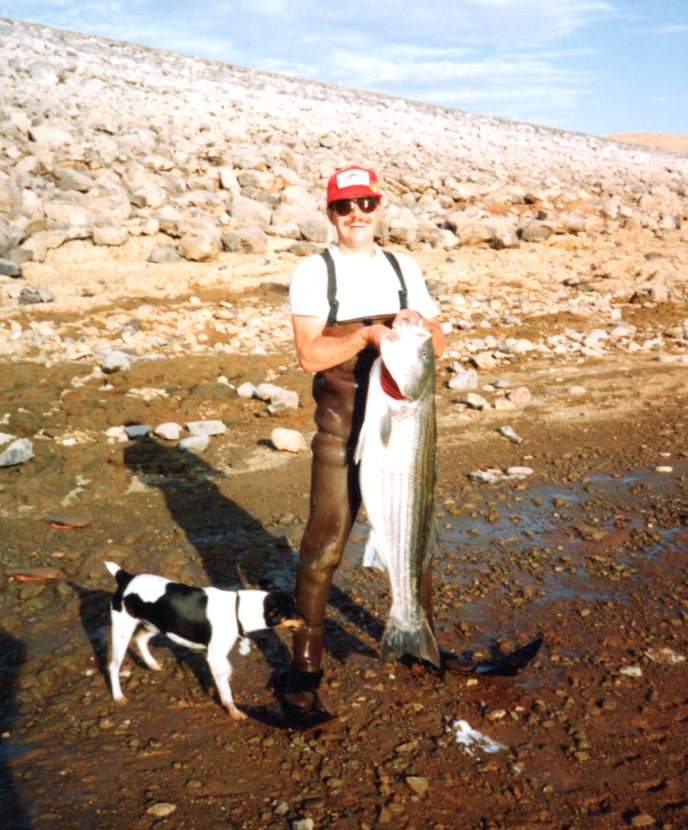
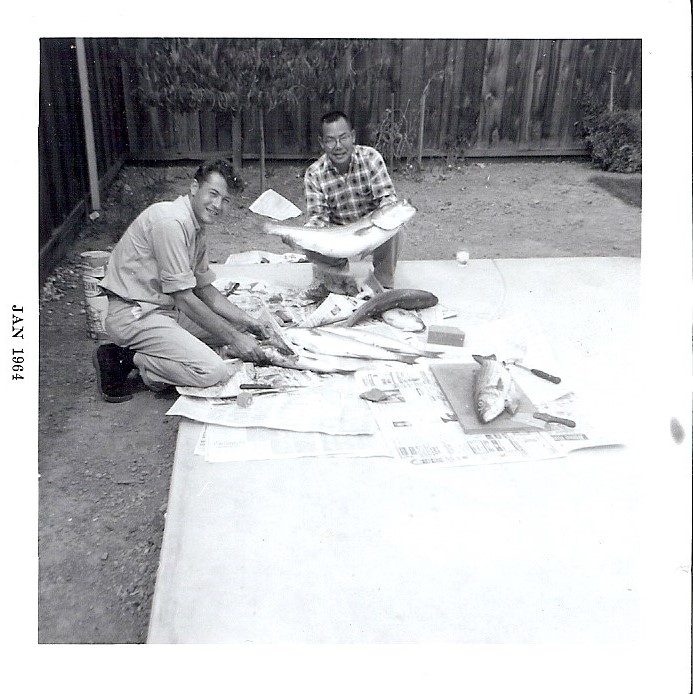
My Dad in 1964 (I was 8)
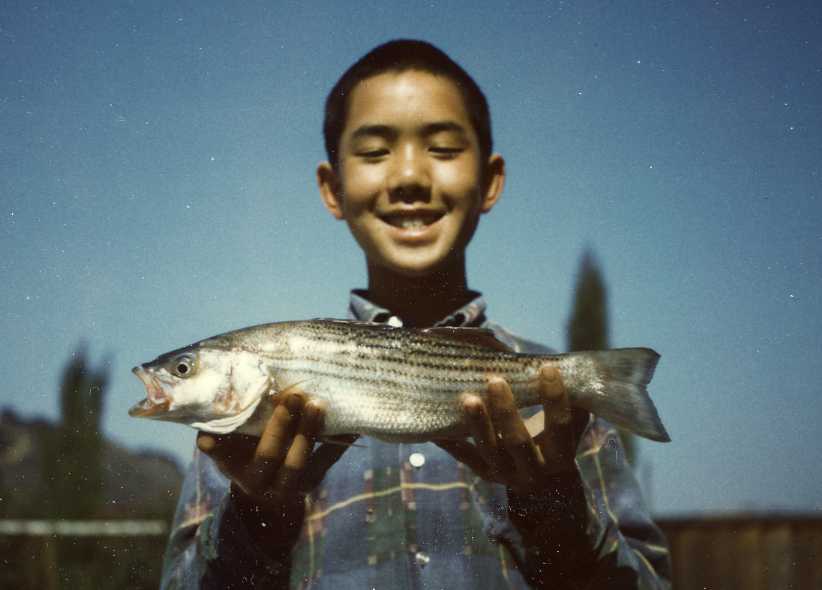
My first anchovy caught Striped Bass in 1970. I was 13 years old .
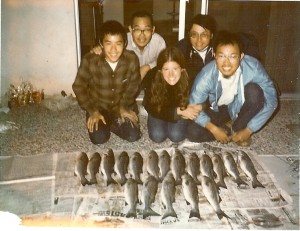
“a mess of stripers” 1973
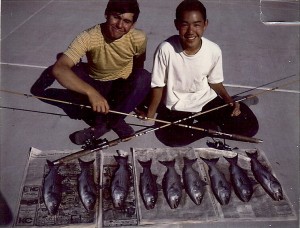
Joey Baiocchi and I with some Stripers 1974
Back in 1972, when I started working at the Millpond Fly Shop, I started flyfishing San Luis off the shoreline primarily for American Shad. The Shad in those days would swim in large schools around the lake . Some were as large as 6 lbs. I have seen dead stripers in San Luis with foot long Shads sticking out of their mouths choking them to death. The American Shad if a forage food for giants and thus the large size of San Luis Strippers. I remember when Kay Mitsioshi who worked at the Millpond back then, showed me how to prepare and eat the roe of large female Shad–it was a Japanese delicacy and he encouraged me to bring him back some hens. It was also in the 70s when my boss, Len Bearden, started to seriously fly fish San Luis for large stripers. He made San Luis his home water. By 1975 Len had accomplished the Grand Slam of Saltwater Sailfish Flyfishing–having caught every species of sailfish on a fly when saltwater flyfishing was in its infancy. Len approached fishing San Luis like a scientist. He started keeping detailed records of the wind weather conditions. He kept detailed records of fishing days on the water and recorded all of Al’s observations when they spoke. Fishing it almost twice weekly for over 5 years, Len knew every nuance of the Lake. When I fished with him, it was not unusual for him to be the only guy in a line of float tubes constantly hooking fish which taught me the most enlightening lesson I ever learned from him – there is more to catching Stripers on San Luis and ONeill Forebay than time on the water and luck. Everyone who fished with him accept Al, was at a disadvantage because he knew things that other did not. I watched him fish next to Dave Whitlock, and other famous fishermen and embarrass them on that lake. He use to tell me I was holding my lip wrong which back then meant I was not smoking a cigar. Len’s friend Al Whitehurst lived in the bay area and would come into the store and buy materials for all sorts of odd flies to fish the lake. He too was enamored with the stripers of San Luis Reservoir. They would communicate weekly about the fishing on the lake and between the two of them their knowledge of the lake compounded. In the next thirty years, the two of them would own all the IGFA Fly Caught line class World Records for Landlocked Stripers. Al eventually moved to Los Banos and remains there to this day–in my opinion, he is the world’s authority on San Luis fly fishing. The fly of choice back then for Len was yellow clouser minnow
It’s all about the weather! If you read the diary carefully, some of the best days Len had were in some of the worst weather–storms, wind and fog.
Len Beardend Striper Fly Fishing Diaries 1991-1992 Bearden Striper Diaries 91-92
Catch Journal 91-94 by MengSyn
Recent Landmark Catches
The Trifecta of 2016
The month of November 2016 was the month I broke the 20 lb mark that I eluded me for years. Conditions were ideal – water down to 18 percent, good weather and solonar. Big Flies, Big Fish. Don’t give up targeting big fish no matter what.
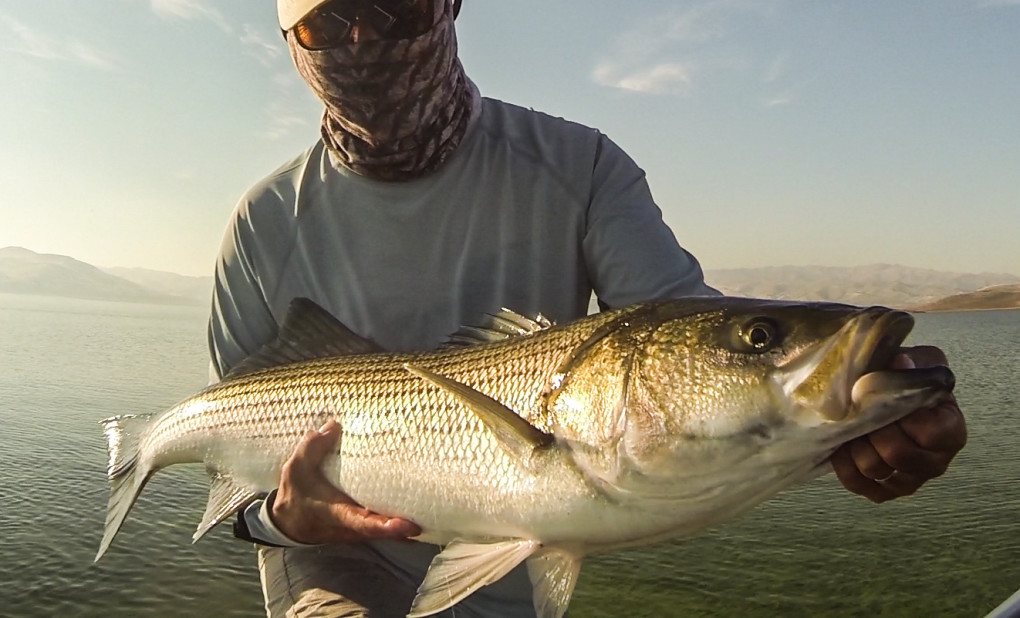
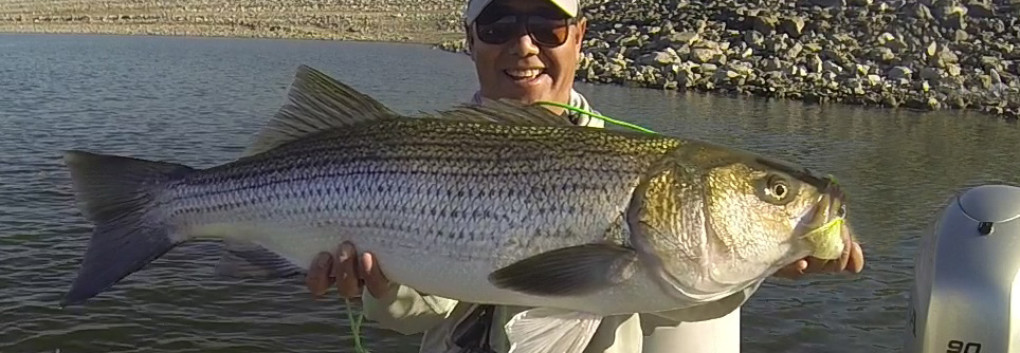
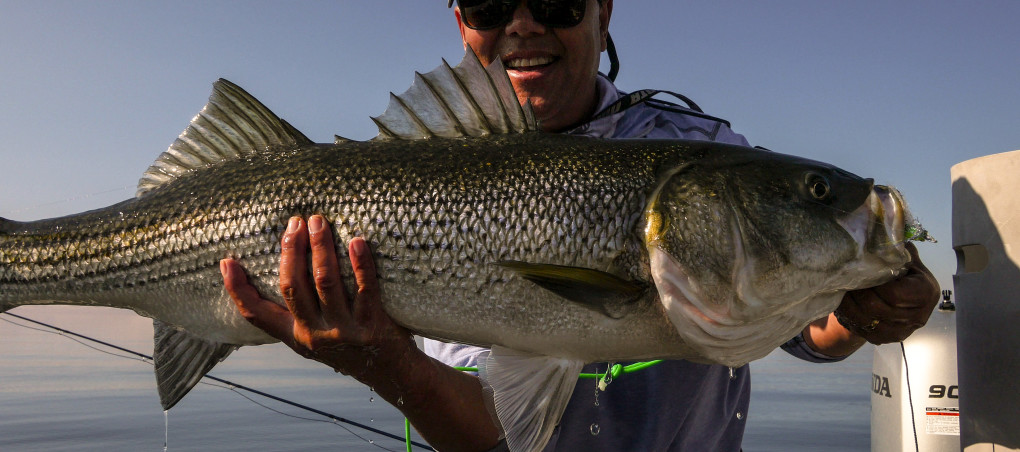
Steve Santucci’s 40 lbr October 2016
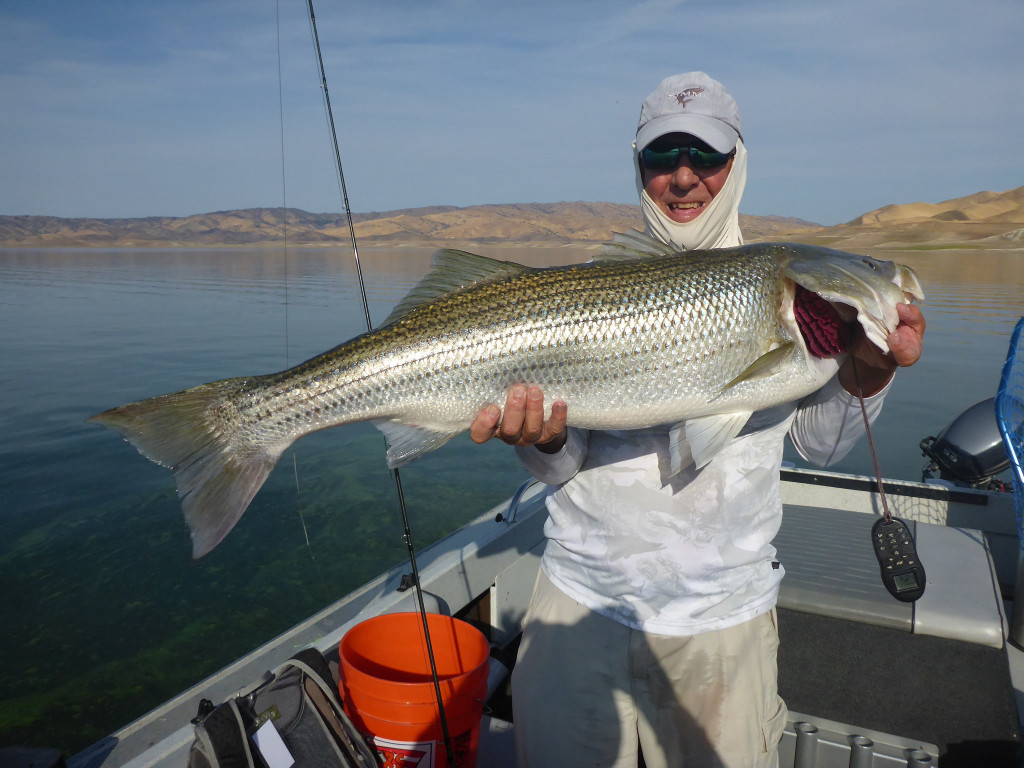
We were on the water by 7:45 and heading across the lake to the rocks of the dam. I hooked into the first fish within 5 minutes and the bloody thing was into my backing 100 yards in 30 seconds or less. We knew it was a good one.
When we saw color, Ed says to me that it’s over 30 and I say don’t know about that but it’s a damned good one. Turns out it was 32 pounds – yes, I weighed it on the boga; we took a few photos and I took plenty of time to be sure she was properly revived. She swam away in good shape heading downward for deep water. Needless to say that I was stoked. It’s the best one for me in quite a while. I managed two other nice fish, an 8- and 9-pounder and a few smaller fish. Ed ended up with 18 fish from 18 to 20 inches; and we both dropped a few. Only a few days ago Ed hooked a monster that got into his backing more than a hundred yards before rocking him off.
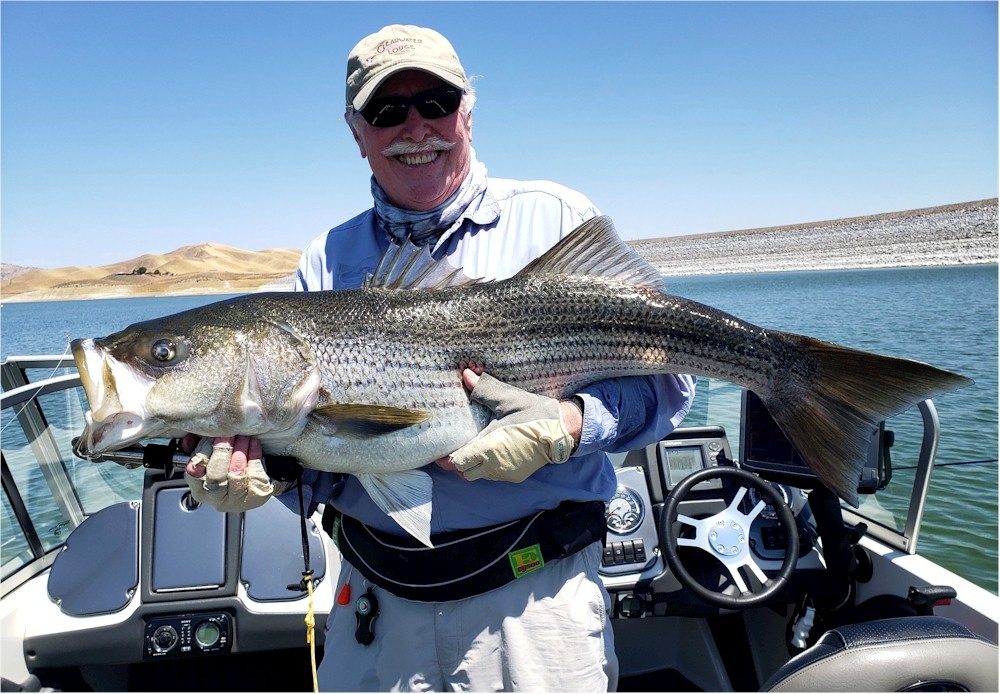
32 lbs caught at Romero on a grey and white jig hook clouser
I happened on your site today, and what a wonderful and informative read you gave me. The history of the reservoir, and the fishing detail are fascinating. The Kennedy video was a treat and a nice history lesson. Thank you so much for sharing your experience and wisdom.
I rewatched that Kennedy speech after your kind words . I was 5 years old when he gave it. Listening to the words were inspiring and also sad that we are no longer a country like that . What vision he had . It seems it’s every State for themselves these days even though the Federal Government is chipping in for the Dam Project 2023.
I don’t fish that much now but growing up we did especially at San Luis. My Dad was the Chief of the San Luis Field Division for 20 years with DWR for 40 years. He did always know the best places to fish. This article brought back some great childhood memories.
Just a great history on an amazing body of water. I have fishes it a handfull of times and also fished the creek outlet for crappie.
Great read, thank you
Great article Meng, I will try to get out to Checkpoint 12 this weekend to just check the place out and enjoy the outdoors with no expectations but to just to enjoy myself in the outdoors with my wife.
Where would you recommend shore fishing with 8-12 year olds?
What’s the best bait to use?
Thank you.
You could try anchovies and live minnows which is what I fished with when I was 8-12. Call Coyote Bait and tackle and they will set you up.
This is one of the best reads I found yet on San Luis fishing.Thanks’ for your time and expertise on San Luis. I’ve been fishing for the 30lb bass my self for 30+ years off and on. I also keep a log book noting Weather, Water Levels, And Solunar etc: . I put together some short videos fishing there in October 2016 when the water was very low “almost dry” and then again June of 2017 when the reservoir was full to the top. here is a link to the videos.
Thanks again you rock!
https://www.youtube.com/watch?v=S5DS5thgdsU
What happened to the link? I was excited to go see
Wonderful historical prospective concerning one of my favorite fish ! I currently live in Redding and fear if the tunnels are built Shasta will become a mud hole and the Delta will be destroyed!
Most Nor Cal people are so ignorant of the threat that Southern California Water interests are to us. The most powerful weapon we fishermen have is the endangered species act and now our Senators are starting to waffle on that.
Fishing all over the state has Declined in a big way. You are correct to point out Regulations. Especially nearby population centers, I am of the opinion that ALL decent game fish should be Catch and Release only. How much longer until there are Zero fish in our waters, well just look at the graphs. Less than a decade left IMO. It always amazes me to see someone keep a fish in the bay area. Mercury is a serious carcinogen. If you want to keep something, keep a carp or bluegill, save a baby bass or trout this way.
National Geographic did a documentary on California Water that I think all fishermen should see–WATER & POWER: A CALIFORNIA HEIST. The politics and economics of water in California is heavily weighted against fish by the politicians that run out state. The only thing that stand between total destruction of the NORCAL water ecology is the endangered species act which is now under attack by California Politicians. We as fishermen are a very weak lobby without the endangered species act.
Great blog! Thanks for taking the time to put this together! ??
Great help, thank you!
Hello, do you allow guest posting on mengsyn.com ? 🙂 Let me know on my email
Thanks for share your post, Please checkout my article below:
Fishing 101: Top 10 Tips On Fishing For Beginners
https://guidancesports.com/fishing-for-beginners/
What a fantastic article, thank you.
This is my first time on this blog. I have fished my whole life but not so much for stripers. I live in Mountain View and would like to go fishing with someone who regularly fishes at San Luis. I have rods, lures etc. I am happy to buy all the bait, beer, gas, whatever it takes. Feel free to email me at wsmilestone@gmail.com if you have interest.
Thanks,
Will Stuart
I see you don’t monetize your site, there is one cool method to
earn extra money, it will work with your website perfectly,
just search in google for; tips and tricks by Fejlando
Any current reports for O’Neil Forebay for stripers on shore fishing?
I am very new to fishing and trying to learn as much as I can. We are going to San Luis and I wonder if you could recommend a good spot for shore fishing? I also have a kayak but I’m concerned about fishing from it after all the warnings about wind.
Jennifer Mitchell
Jeniffer, If you like fishing from a Kayak, I would try fishing in Oneill Forebay first. Most of the successful Kayakers in the forebay troll a lure or plastic swimbait around and do well. The Forebay is pretty small and you wont get into big trouble far from shore anywhere you fish on it. Also, I think you are safer in a Kayak than a boat if for some reason the wind does build. If you really want an advantage fishing the forebay, you can check out Coyote Bait and Tackle. They have recent fishing reports and they sell jumbo minnows. Live bait is pretty much a sure thing if there are fish around. I also like the Fresno Bee Fishing report for current conditions and places to fish. Check 12 is a good spot to fish from shore. Its right were the canal enters the forebay. If you ask the Ranger Station when you get your boat inspection (Make sure your kayaks is dry) they will direct you.
very through and well written. Last Fall the Forebay was poisoned to kill weed beds, the lifeblood of the lake. Now I had heard that this is going to be a regular practice throughout the year. This is very disturbing as many of us fly fishermen from the Santa Cruz Fly Fishermen group like to camp and fish the O’Neill Forebay late summer and fall. How is this going to change fishing there I wonder. Who can we petition to not continue this idea?
Steve Rudzinski
I enjoyed this article and thank you for sharing your experiences and thoughts. Recently retired I have been fishing the Forebay 3-5 tiimes a week by Kayak and in a short time have been catching and releasing numerous Stripers. Like mentioned in your blog most have been between 16-18 inches. Yesterday I caught my best in the Forebay at 26 inches. I unfortunately have seen many people ignore regulations or destroy any chance of the fish surviving when being released. Would like to see stiffer penalties or more being done to protect this great fishery.
For me the quality of the fishing experience at San Luis declined when the federal government transfered managment to the State of California. While a Federal Wildlife area I also enjoyed Pheasant Hunting near the Basalt area and duck hunting by skull boat. I stopped going when Dinosar Point was gated with dawn to dusk restrictions. I am not sure about access at Basalt, but it is probably the same. The Forebay has night access if you are willing to pay the CRAZY HIGH FEES. No point to it really since it fishes better from a boat. The key to fishing the main body is that at this lake, 80% of the fish occupy 30% of the water. When a ware changes with the seasons but is still the rule. I am willing to bet it is as good as ever but whats the point when you launch late or are forced to trailer your boat to early? For me the two most productive windows of opportunity were taken away and for no good reason other than money. What A SHAME.
Steve Johnson;San Jose California
great article. my dad lives in Fresno and talks about fishing here and how it is hit or miss. I now live in VA and we are planning a trip to fish a bunch of different spots in CA. We have gone to Lake Powell for the past two years but I want to stay local this year. Any tips you are willing to share would be much appreciated. he has a little Tracker boat so trolling is an option. Thanks!
Awesome Internet post! Thank you.
On April 21, 1991 Terry Baird, who held the 16 pound tippet record before I did, and I were fishing there in a moderate north wind. From 10:00 am until 7:00 pm we caught between us 22 fish over 15 pounds, including at least 8 over 20, a 30, and a 37, with many 4 to 15. That night Terry christened the Bay of Pigs, as we barbecued a fillet.
Next morning, with calm conditions, one fish between us about 20 inches.
The number of big fish has dwindled, but it is still a great fishery.
No I don’t
Meng–Do you know how the Bay of Pigs got its name?
Hello Meng,
I have been fishing for striped bass at Oneil forebay & San Luis reservoir for many years. I live about a mile away from Calero reservoir . I noticed the size of fish shrinking for about 7 years. Oneil forebay used to be a fantastic fishery, not anymore. The average size went from 26″ to 16″ in only 7years and that is alarming! Fishing pressure and current regs are to blame. I am seeing the same thing happen at San Luis reservoir . 6 years ago you could consistently catch 24″to 30″ stripers at both lakes with a good number of larger fish mixed in. The big schools at the Forebay are 16″ to 17″ now so that would tell you that most 18″ fish and above have been taken for eating. The one thing I have noticed is the number of bank fisherman and boats loaded with families for the sole purpose of catching and keeping as many fish as possible. I remember a trip a couple years ago where there were 8 boats overloaded with family members catching & keeping every fish. I called cal tip and they caught them with over their limit and undersized fish as well. This is a huge problem that needs to be addressed if we hope to improve the fishery as a whole. I see report after report of undersized fish being caught everywhere.
I just reread a comment you made on my blog 4 years ago and you mentioned you live a mile from Calero as I do. Are you still fishing Calero and San Luis. I would love to talk to you about Calero.
Send me an email if you are interested. msyn@carabelli.com
I want to take the time to thank you for this great blog. I live in San jose and SLR is my go to spot for some striper fishing! So you can imagine how educational this was for me.
Although I’ve never caught a striper over 25 inches I still manage to have a great and relaxing time out in the main lake. I em however open for suggestions as to how or where to hook some good size fish on shore ?
Again thanks for this great blog and long live the preservation of the SLR.
Thanks for those nice words. I still enjoy catching even the little stripers at San Luis. It’s ben a long time since I fished from shore but the guys at Coyote Bait and Tackle have good reports and all the baits you might need from bloodworms, grass shrimp, anchovies, sardines and live jumbo minnows.
Greetings, Doc.
What a pleasure to discover Len’s diaries and to relive the glory days.
Thanks.
Al.